A missing tooth can change more than the way you chew. You may find yourself covering your mouth when you laugh, choosing softer foods, or worrying that people will notice the space. If you have been told you need a bridge, it is reasonable to ask about dental bridge alternatives before making a decision. There is no one “right” replacement for every patient, and a thoughtful conversation should include your health, comfort, timeline, and budget.
At Classic Dental Arts, we believe treatment decisions should never feel rushed. You deserve a clear explanation of your options, including what each one asks of your teeth, gums, and long-term oral health.
When Is a Traditional Bridge a Good Choice?
A traditional dental bridge fills a missing-tooth space with an artificial tooth supported by crowns on the teeth beside it. It can restore appearance and function relatively quickly, and it may be an appropriate solution when the neighboring teeth already need crowns because of large fillings, fractures, or extensive decay.
The trade-off is that those neighboring teeth usually need to be reshaped to hold the bridge. A bridge also needs careful daily cleaning underneath the replacement tooth. Over time, decay or gum problems around the supporting teeth can affect the entire restoration.
That does not make a bridge a bad option. For many people, it is a dependable choice. But when healthy teeth sit next to the gap, or when preserving bone is a priority, it makes sense to compare other paths.
Dental Bridge Alternatives to Consider
A single dental implant
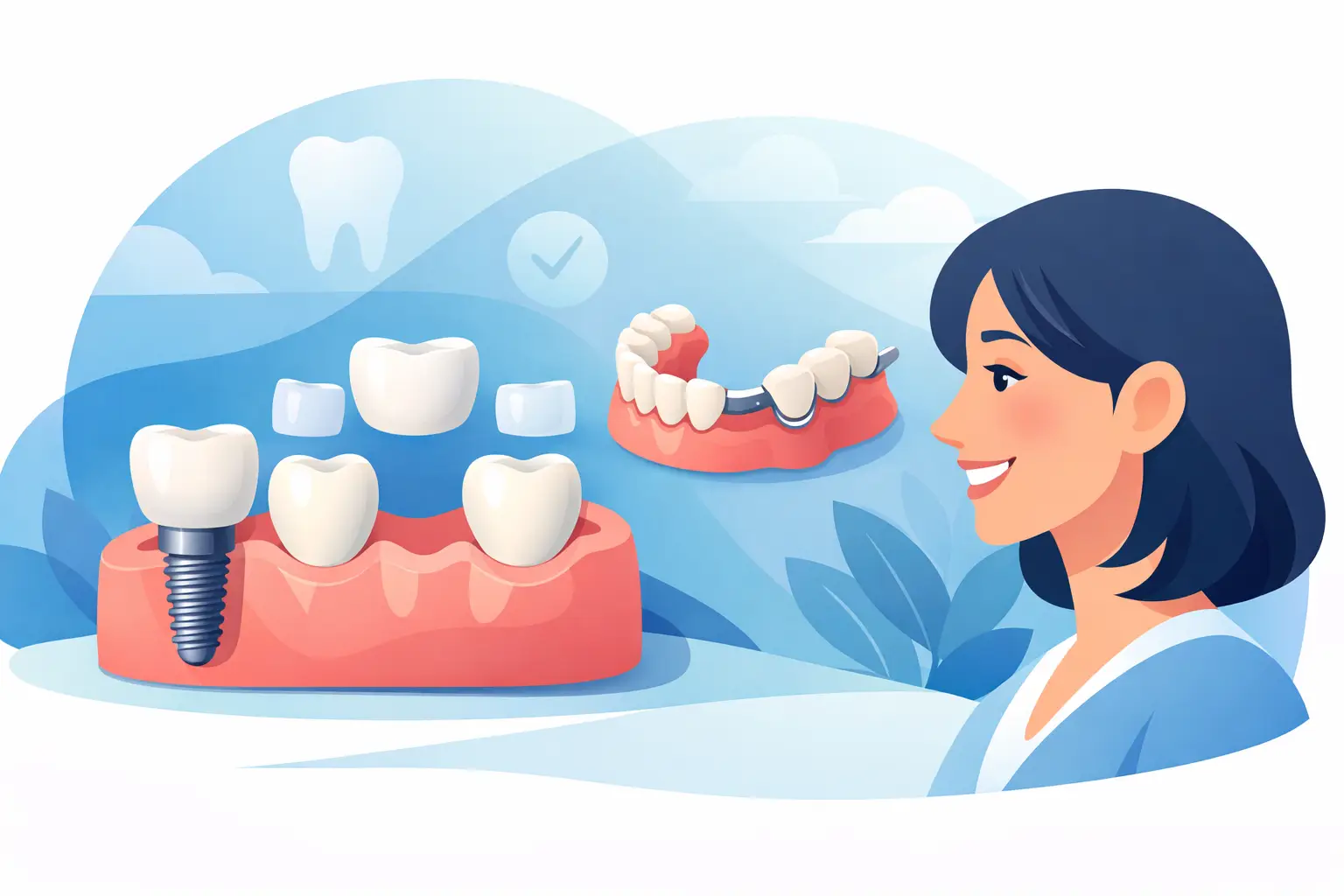
For one missing tooth, a dental implant is often the closest replacement to a natural tooth. A small titanium post is placed in the jawbone, where it supports a custom crown after healing. Because the implant stands on its own, the teeth beside the gap do not need to be filed down or used as supports.
Implants also stimulate the jawbone in the area of the missing tooth. That matters because bone naturally begins to shrink after tooth loss. Preserving bone can support the shape of your face, your bite, and future treatment options.
An implant does require a surgical procedure and a healing period. The total timeline can be longer than a bridge, especially if you need a bone graft or have an active gum infection that must be treated first. It can also carry a higher upfront cost. Still, for patients with healthy gums and enough bone, it may offer excellent long-term value because the implant is independent of nearby teeth.
An implant-supported bridge
When several teeth in a row are missing, individual implants for every tooth are not always necessary. An implant-supported bridge can replace multiple teeth using implants as anchors rather than natural teeth. This approach avoids placing crowns on healthy neighboring teeth and offers more stability than a removable appliance.
The number and placement of implants depend on the length of the missing area, your bite, and the condition of your bone. This option requires careful planning, but it can be especially helpful for someone who wants a fixed restoration without replacing every missing tooth with its own implant.
A removable partial denture
A removable partial denture replaces one or more missing teeth with a custom appliance that rests against the gums and attaches around existing teeth. It can be a practical choice when several teeth are missing in different areas, when surgery is not appropriate, or when an implant is outside the current budget.
Modern partial dentures can look natural, but they do take an adjustment period. They must be removed for cleaning, and some patients notice movement while eating or speaking. The clasp design, fit, and materials all affect comfort. A well-made partial denture should feel secure, but it will not function exactly like a natural tooth or an implant-supported restoration.
For many patients, a partial is also a useful transitional option. It can restore a visible space while you take time to plan for implants or another more permanent solution.
A resin-bonded bridge
A resin-bonded bridge, sometimes called a Maryland bridge, uses small wings bonded to the back of neighboring teeth instead of full crowns. Because very little tooth structure is removed, it can be a conservative option for certain patients.
It tends to work best for a front tooth, where chewing forces are lighter. It is usually less suitable for a back tooth, where biting pressure is stronger. The bonded wings can occasionally loosen, particularly for patients who grind their teeth or have a heavy bite. Even so, it may be worth discussing if preserving healthy enamel is your main concern.
Orthodontic space closure
In a few situations, orthodontic treatment can move teeth into the open space rather than replacing the missing tooth. This is more common when a space has been present for years, when crowding exists elsewhere, or when a younger patient is still developing.
Closing a space is not right for every smile. The position of the missing tooth, your bite, facial balance, and the condition of the surrounding teeth all matter. But it is an option that is sometimes overlooked, particularly when the gap is small or located in the front of the mouth.
Leaving the space open
Some patients decide not to replace a missing tooth, especially if it is far back in the mouth and not visible. That can be reasonable in select cases, but it should be an informed decision rather than a default one.
Teeth can shift toward an empty space over time, changing the bite and making food traps more likely. The tooth above or below the gap may also move out of position. Bone loss will continue in the area without a tooth root or implant. If the missing tooth affects chewing, speech, or confidence, leaving it untreated can have a greater day-to-day impact than expected.
How to Choose Between Dental Bridge Alternatives
The best choice is usually less about finding the “best” treatment in general and more about finding the best fit for your mouth. A dental implant may be ideal for a healthy patient missing one tooth, while a partial denture may be a sensible, affordable option for someone missing several teeth or managing medical limitations.
Your dentist should evaluate the health of the neighboring teeth, gum condition, bone level, bite forces, and the cause of tooth loss. If a tooth was lost because of untreated gum disease, for example, stabilizing gum health comes before placing a new restoration. If you clench or grind, protecting a bridge, implant crown, or partial denture may require a nightguard.
It also helps to consider the long view. A lower initial cost may be appropriate, especially when finances are tight, but ask what maintenance or replacement could look like over the years. Honest cost discussions should include the expected lifespan of each option, not just the first appointment.
Questions Worth Asking at Your Consultation
A good consultation should leave you with fewer unanswered questions, not more pressure. Ask whether the teeth next to the space are healthy enough to preserve, whether you have enough bone for an implant, and what treatment would best protect your bite over time.
You may also want to ask how long each option takes, what the recovery is like, how it will feel while eating, and what happens if you wait. If anxiety has kept you away from dentistry, say so. There is no judgment in needing extra time, clear explanations, or a plan broken into manageable steps.
A Choice That Should Feel Like Yours
Replacing a missing tooth is not only a cosmetic decision. It can protect the way your teeth work together and help you feel comfortable smiling, eating, and speaking. But you do not have to decide based on a quick recommendation or a fear of making the wrong choice.
Bring your concerns, your budget questions, and your goals to the conversation. With a careful exam and a no-pressure discussion, you can choose a solution that feels realistic now and supports your smile for years ahead.